
A Disruptor in Kolkata
One month in a city that refuses to stop, and a traveller trying to stay out of the way.

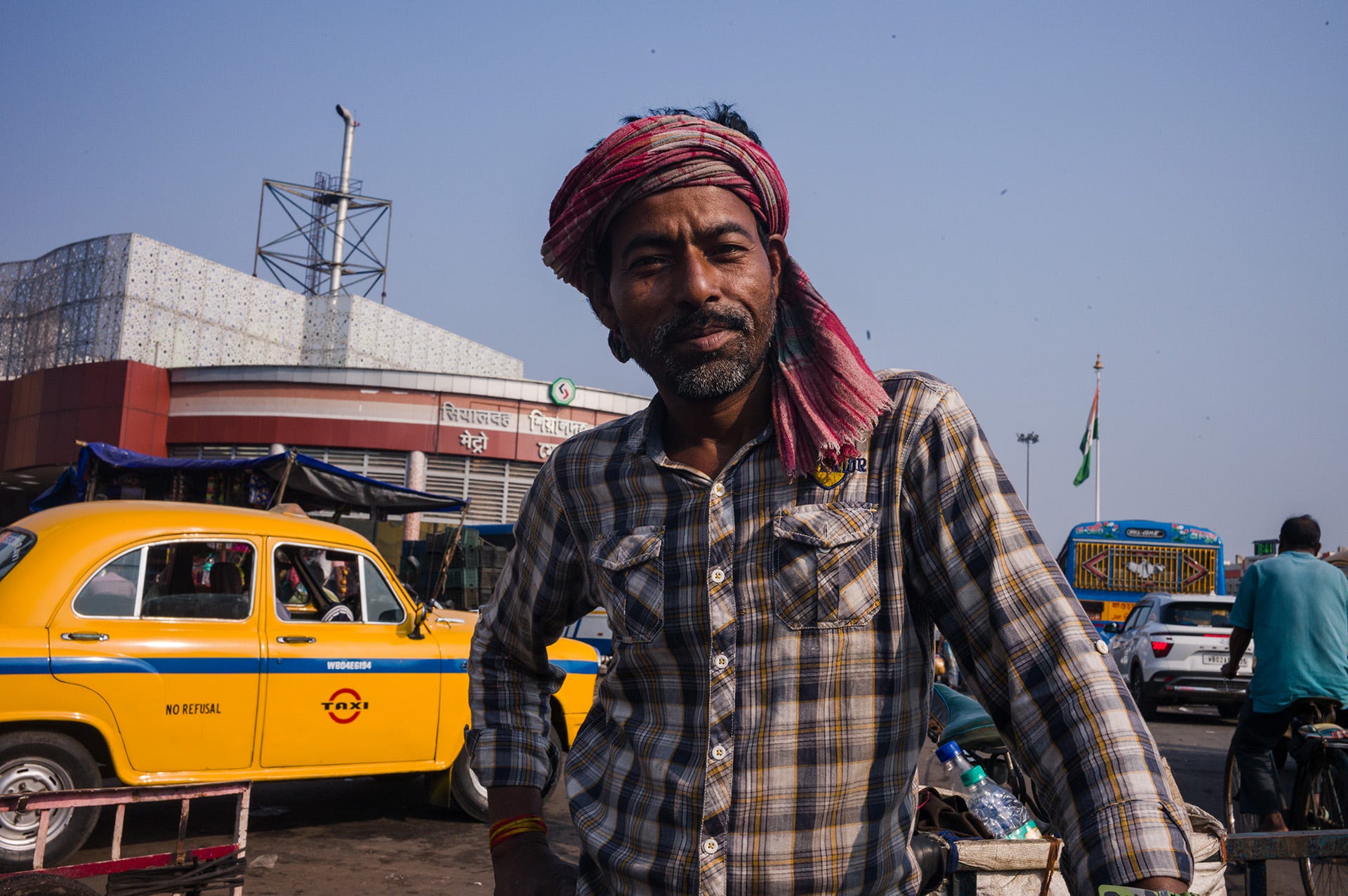
The taxi pulled over and the driver announced we had arrived. Having no other choice than to make the payment and exit the fuel-driven cocoon I opened the door and immediately started to disrupt the flow of the streets. I took out my suitcase and backpack and the car drove off. In the dark of the evening I was left standing on a street that had no time to welcome my presence. Men pulling wagons & rickshaws, cars and taxis all moved with urgent purpose and I did my best to dodge. The address I had for my homestay was vague, so I joined the street’s chaos, searching for clues while dragging my suitcase among the carts and rickshaws.
Finally I got a hold of someone on the phone number given to me by my host. It was a non-English speaker answering and our efforts to understand each other were mostly unsuccessful. After a while a 50-year old man dressed in a modest dhoti appeared in a small opening between two jewelry shops and waved at me with a stern expression. I navigated towards him and followed him in through the alley.
We walked a maze of small streets before he turned into an opening in the building and started to walk up some stone stairs. I followed him. As I entered I got eye contact with a neighbor working in his small craft shop. Trying to be polite I greeted him with a friendly ‘Hello’. The effort was not returned and I continued to follow my guide up the stairs dragging my heavy suitcase. As I got up I could hear the neighbor mocking my ‘Hello’ by repeating it with a silly voice like a broken record.
I was shown my room. The walls were painted pink and turquoise and it was decorated with collections of Bengali artifacts. There was a door separating the room with the living space of the rest of the family. The shared bathroom meant I had to enter their living space when nature called. A family of 6 living in a space that was basically nothing more than a stove and beds. My room wasn’t big, but realizing they’d given me as much space as the six of them shared, I felt lucky.
The crying of the infant quickly became the main melody of the soundscape, sometimes mixed with the laughter of a social gathering of young adults sharing Mahua in the alley below. After some rest on the stone-hard bed I felt a strong urge to find some beer. I went out in the night searching for a bar. Many of the pavements were filled with the homeless trying to get a night of sleep. The luxurious arrangements were using loose tarp against the wall buildings with only stones holding them in place. Less fortunate sons had to resort to only thin blankets covering their bodies. Some families still awake would lay tight together on a mattress watching videos together on a smartphone.
I did my best not to disturb anyone sleeping as I went on with my beer mission. The streets were very quiet, and no restaurant let alone any bar was in sight anywhere. My morale began to shrink and I thought to myself that finding a warm chair and a cold beer had been quite naive on my part. The city seemed too busy with trying to survive to have any time for the pleasures of life.
The minutes became an hour and just as I’d lost my hope I saw a queue lining up on a distant street. As I got closer I saw the sign ‘Broadway Hotel’ above the crowd.
This looked promising. I took my place in the line but shortly I got asked by one of the porters if I was alone. I nodded and he told me to follow as we walked in through the back door and I was shown a place in the bar. It looked like the only stool available.
The room had a high ceiling and it was absolutely crowded with people. Groups seemed to discuss and argue loudly while the loners sat concentrated with a newspaper. I sat down at my appointed spot in the bar and quickly ordered a large Kingfisher and a dish called aloo chana while opening my copy of ‘City of Joy’. Finally I felt Calcutta had shown me a warm welcome.
After a week of sickness & basically living in my room I started to recover and felt I really had to get going with working the city. For any photographer imagining Kolkata, one of the first things that comes to mind is the flower markets and the ghats. I decided this could be a good start so I walked the long Mahatma Gandhi Road leading up to the 165 year old flower market. Standing at the foot of the iconic Howrah Bridge and looking down over the market I quickly understood its fame. Every inch was cluttered with colour & movement. Elevated observation wasn’t enough though - time to get down and enter the chaos.
Being a street photographer in India is like Kathak dancing – you’re constantly moving around obstacles, reading the space with every step, finding your angle without disturbing the performance happening around you.
I went down a lane leading from the market, and saw stalls on every side with transactions happening all around. Big trucks loaded with goods tried to move forward—some patiently, others less so—in both directions on this narrow road crowded with people. I came towards a ruined temple gate. The strong Marigold-colored rays from the morning sunlight cut through the portal and two small boys were playing football, using the old pedestals from the ruin as goal posts. I was intrigued and watched their joyous game as I continued through the portal and down the steps of a small Ghat(steps leading down to a body of water).
I sat down on the steps and watched over a collection of people bathing & doing laundry in the river. A bunch of kids appeared around me. 3 girls and a boy to be exact. They proudly displayed an impressive set of transparent stones of different colour tints they held in their hands but I failed to grasp their explanation of what they were or their purpose. One girl, no more than eight, showed a new piercing she recently had done in her ear tips. As they noticed my camera the girls started posing for me against one of the walls of the Ghats. Happy to share a small moment with them I accepted their playful invitation and started to photograph them. The boy, with a photogenic face and eyes that didn’t escape me, was too occupied in his own playful world to join the girls. Suddenly an adult voice shouted and the children began rushing away. As they left they shouted ‘skul!’ – a Bengali word borrowed from the English word ‘School’.
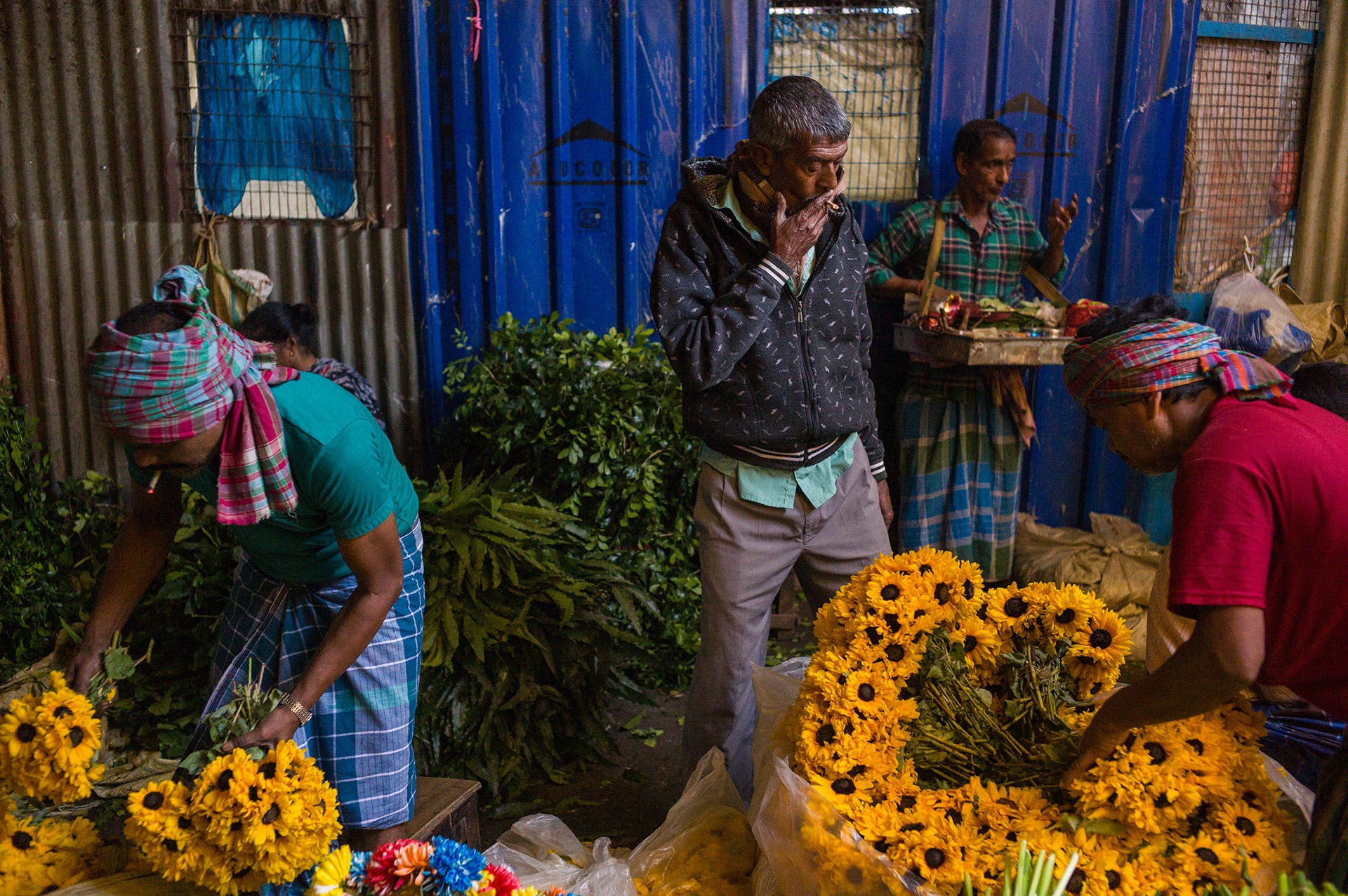
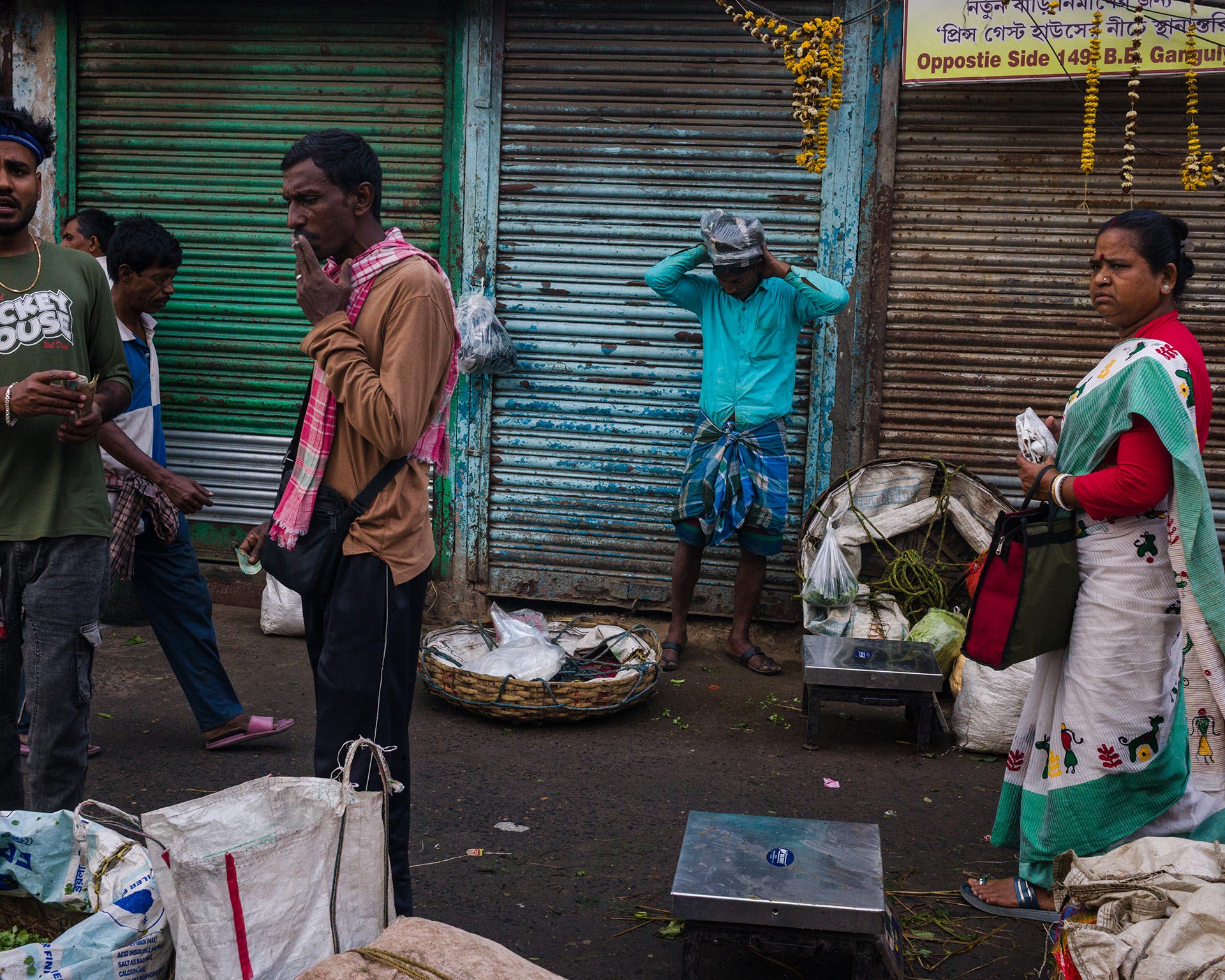
My favorite location in the city came to be in the areas around Koley market and Sealdah. It’s less famous than other parts of the city, but no less energetic. It has a very dynamic appearance. From colourful walls on the buildings, crews filling trucks with sacks of grain, street vendors selling anything from fruit to kitchen supplies and a clientele ranging from aunts in cotton saris to youth in hip-hop wear. The main choice of garments for the hard-working is lunghi bottoms with a simple shirt or tank top.
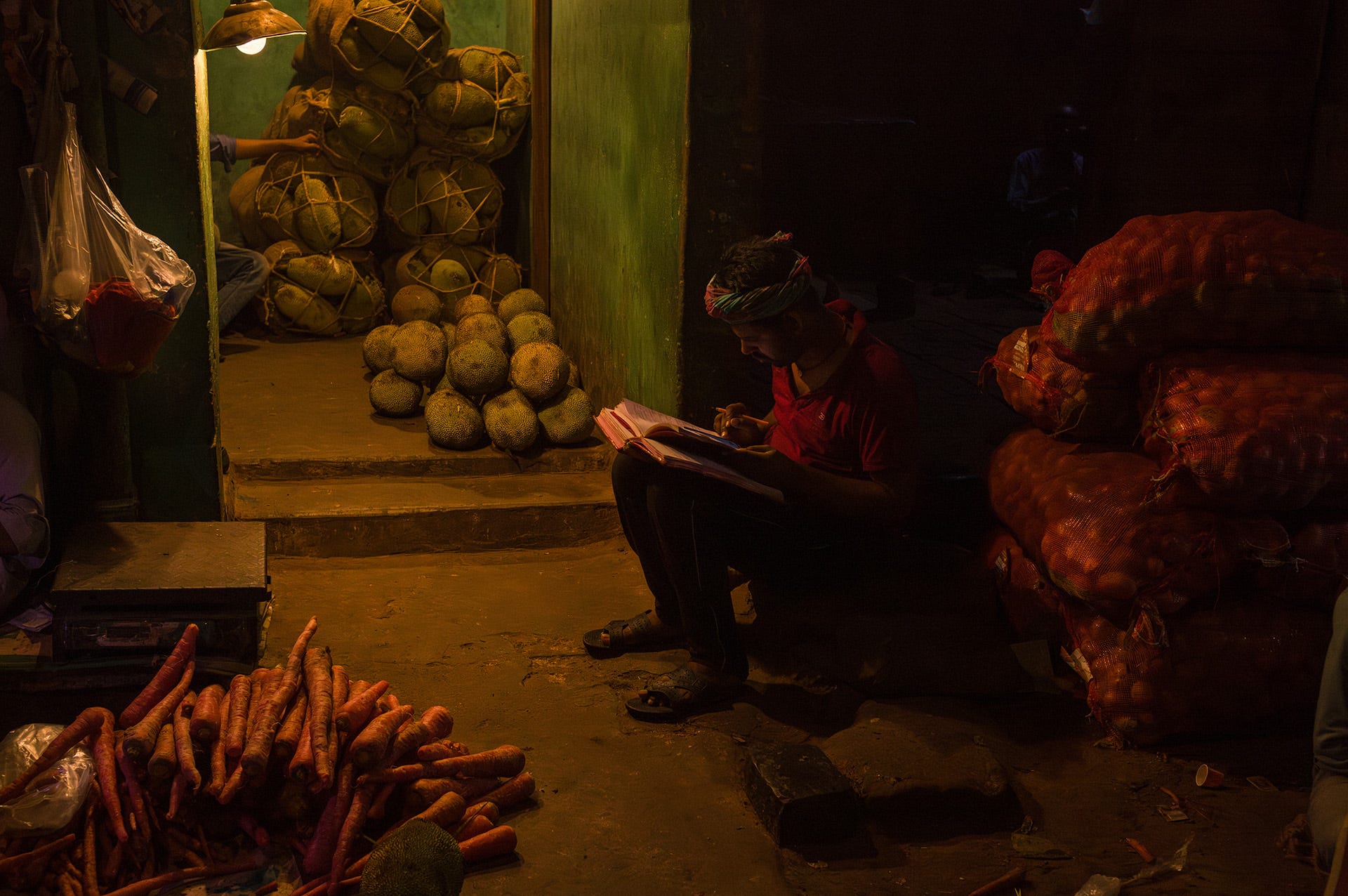
Close to the main area, countless unnamed interior markets could be found down narrow alleys and unpretentious openings. These places hardly get any natural light so the vendors illuminate their goods with spotty bulbs of various colours. This creates a theatrical chiaroscuro setting with dramatic shadows and dim, vivid highlights. Sometimes it makes you stop and wonder if you are really experiencing this for real or if the curtain will go down at any point.
One day as I was fishing for a composition an older boy walked up to me and started talking. He told me he was supposed to go to school but was a little bit late so he was afraid of punishment and wanted to wait until class was done. He took me to his favorite pastry shop to kill some time. A small vendor modestly located under the bridge, a busy tunnel leading to Sealdah Station. He offered me a rasgulla(cheese-based ball soaked in syrup) as we chatted about the differences of the Swedish and Indian school system. I found his acceptance of the situation interesting – instead of rushing to make up for lost time and take his punishment, he adapted the situation into a social moment with a stranger.
Later, as I was slowly sipping beer in Trincas, a former colonial teahouse converted into a restaurant, I sensed that maybe the usage of time here contrasted that of Mumbai, where cafes and limited bar scene felt mostly inhabited with young people on dates, businessmen with headsets and entertainment professionals pitching ideas to each other. In Kolkata I felt they were more filled with regular people of all ages using their free time to socialize, for the sheer reason of having a good time together. Suddenly the waiter was there, pulling my focus off my book as he asked if I needed another refreshment. I agreed without hesitation and got back to my reading. As a Kingfisher landed on my table(the bottle, not the bird), of course after the mandatory ritual of feeling & accepting its coldness, the house band started playing what I understood as popular Bollywood hits.
One day, as I was rushing home from a morning session around Sudder Street, the sky opened. In less than a minute I went from bone-dry to completely soaked. Having committed to taking a walk rather than the convenient taxi, there was no turning back. The taxis quickly became unavailable, and the neighborhood offered no shelter of cozy cafes to take refuge in.
With my Leica protected under my shirt, I took to my heels and ran towards my room. Needing a rest, I pressed myself against a wall just barely protected by the roof jutting out from the old colonial building. I was not alone but surrounded by locals who had taken the same shelter. The man next to me started small talk about my whereabouts.
The most common questions you get as a foreigner in India are the following:
Where are you from?
First time in India?
Are you married?
Giving a negative answer to #3 always leaves a certain perplexity. How can a man in his 30s still be unmarried? What is wrong with you? Having answered these questions, the man turned to his friend to share this piece of information. The friend joined in on the sensation. This reaction made more sense later, over a chai in Kumartuli Ghat, when I was told that arranged marriage is still very common in India, and cross-cultural espousals are often frowned upon as families try to shelter their cultural heritage.
Romance is also something that has to be discreet in public. “In the streets of India you can piss but not kiss” is a catchphrase I commonly heard. But seeing young couples is not a rare sight—in fact, it’s quite common. But to manifest mutual attraction, one shouldn’t just be impulsive but try to employ certain tactics. The parks surrounding the Victoria Memorial are a common gathering place for this purpose. There I could see couples seeking anonymous shelter to harvest an intimate moment. Young girls sitting cross-kneed on the grass, some in their sari, some in jeans and t-shirts, with their boyfriend peacefully laying on their lap. Probably speaking softly but ambitiously about their future plans or past week experiences.
I smiled politely to my rain-sheltering comrades and as the rain didn’t seem to go away I continued my run. Already deep puddles in the streets had begun to rise. With no point in trying to stay dry I waded through the water with no other concern than to protect my camera and get home as quickly as possible. I saw a small mouse that had come up from an overflowing sewer. His fur was deep-wet and he stood upon the pavement shaking in self-pity.
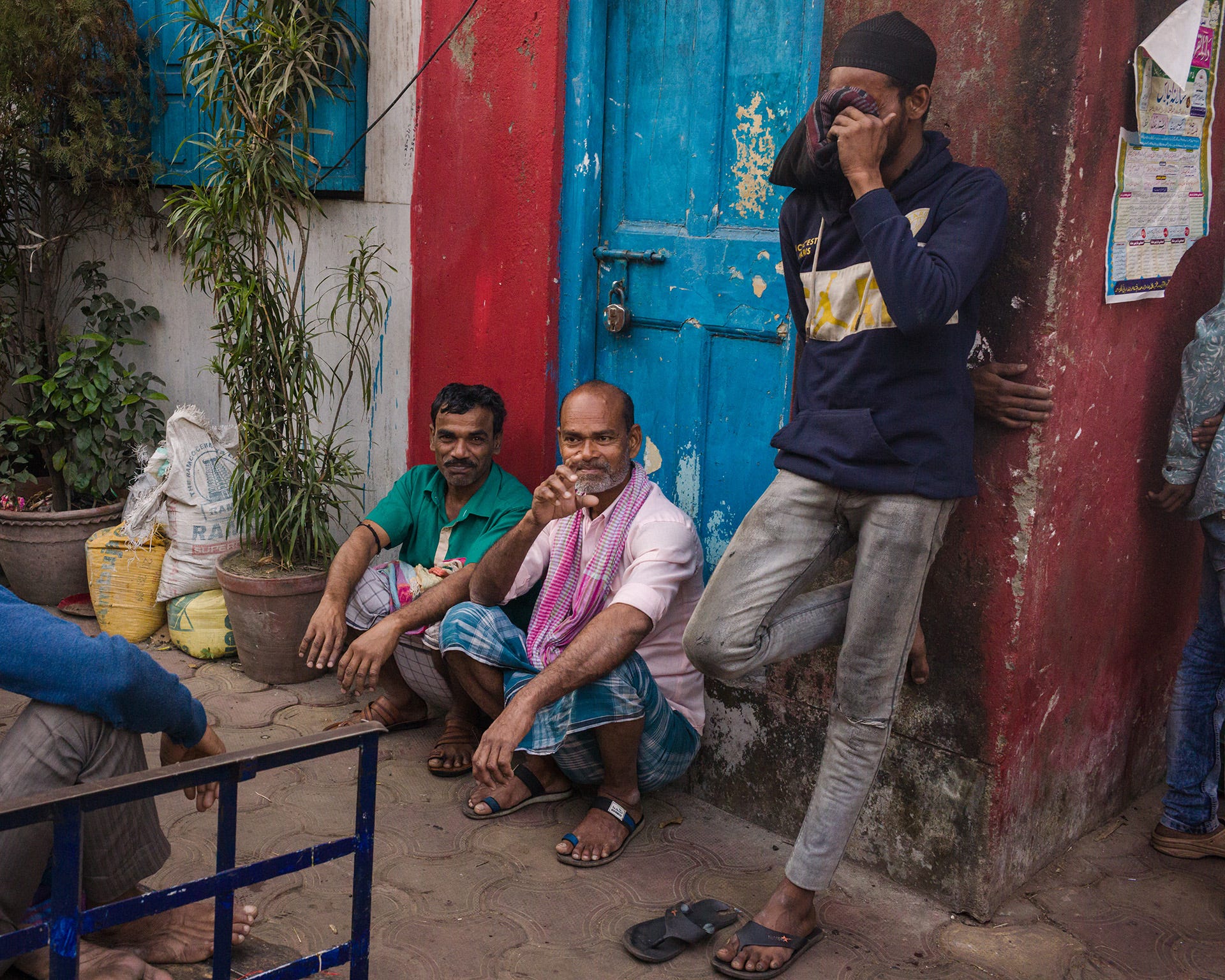
The following Saturday afternoon I was taken by a newly made friend to Kalighat, the ancient temple to worship the goddess Kaali, the deadliest incarnation of Durga. Walking on the Kali Temple Road leading up to the temple we shared the street with both anticipated families strolling in our directions, and others coming back from the worship ritual. Before arriving at the temple we had to stop in a small shop for two reasons. Shoes are strictly forbidden inside the temple area but has no accommodation for footwear, so we had to pay a shopkeeper to keep our shoes while we did our deeds. We also took the opportunity to buy a set of flowers and incense to use as an offering to the fierce quad-armed goddess warrior. Slightly confused with the Bengali tongue flying around I sat down to untie my shoes generating an annoyed sigh from the shopkeeper’s wife as I unknowingly brought in a scarce amount of dirt from my shoes.
Barefoot and an inconspicuous amount of rupees poorer we continued towards the temple ground. Once inside the holy area we were quickly approached by employees speaking enthusiastically, articulating with their arms trying to get us to follow them. I didn’t understand their requests, but they didn’t give up on us even though we kindly declined. As we continued inside I was taken by how long the queue was. What had looked as a dozen or two in line from the entrance suddenly became hundreds as I gained another perspective. I had it explained to me that the employees had tried to get us to pay a seemingly high amount of rupees to access some much shorter ‘VIP’ line, and with a glance of the ‘standard’ queue it didn’t seem like a bad offer. We took our place in the long queue however and started the wait.
After a quarter of an hour my Bengal friend placed a phone call. She told me to stay put and suddenly disappeared on me. As I was standing left alone in the line I could feel the stares surrounding me.
Moments later she came back and asked me to follow. I obeyed and wormed myself out of the crowd lining up between the zigzag metal rail system. We went out of the temple and I was taken to a elderly man. Apparently he had recently been given a favour from my friend’s father and thus was returning the favour by letting us enter through the back door. I showed my appreciation and thanked the best way I could as we entered the ferocious devi’s garbhagriha (inner sanctum).
The sanctum was packed with queue conquerors delirious with religious ecstasy waving their gifts in front of the depiction of the goddess. I was asked to repeat the vow from the temple staff guiding me through the ritual. I did my best and in the end he painted a tilaka on my face and we were steered towards the sanctum opening to behold the goddess. Slipping through the enthusiastic crowd I was finally eye-to-eye with the dark faced Kali. The carved black stone depicting her head is equipped with three intense red eyes and long golden tongue reaching down to the floor. Less than a second later I was shoved away by the rest of the crowd and my time was up. While being shoved away I reached out to put coins in the plate held out by the temple worker as instructed. Once we got out of the temple our energy was high. I thanked the man who had helped us once again and we went to the store to grab our shoes. I was asked what I wished for when I stood in front of the goddess. Wishing was not at all on my mind as I had just tried to make sense of what I witnessed. My friend claimed I owed her a beer for allowing me this fast-track experience. I nodded in agreement.
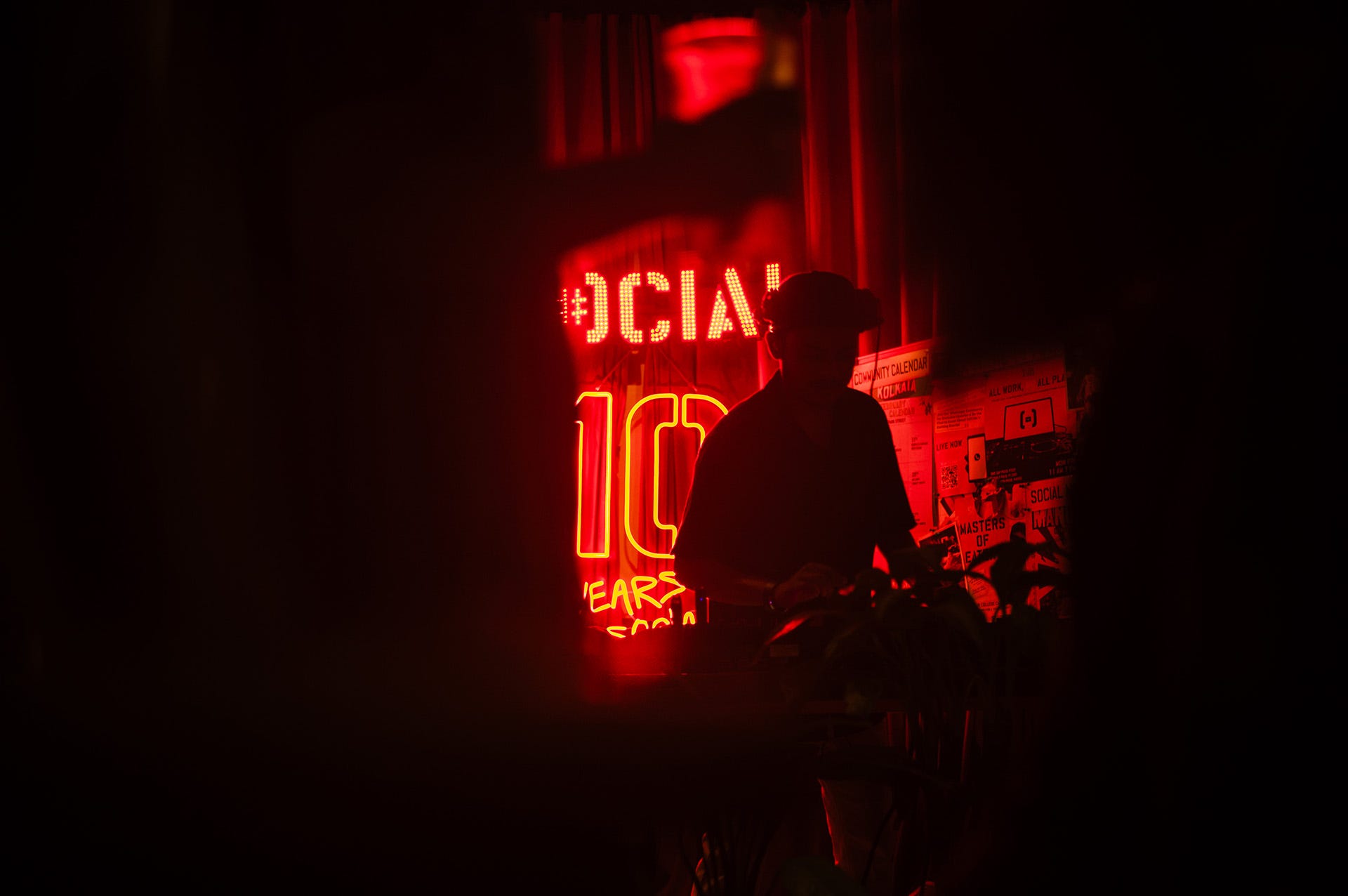
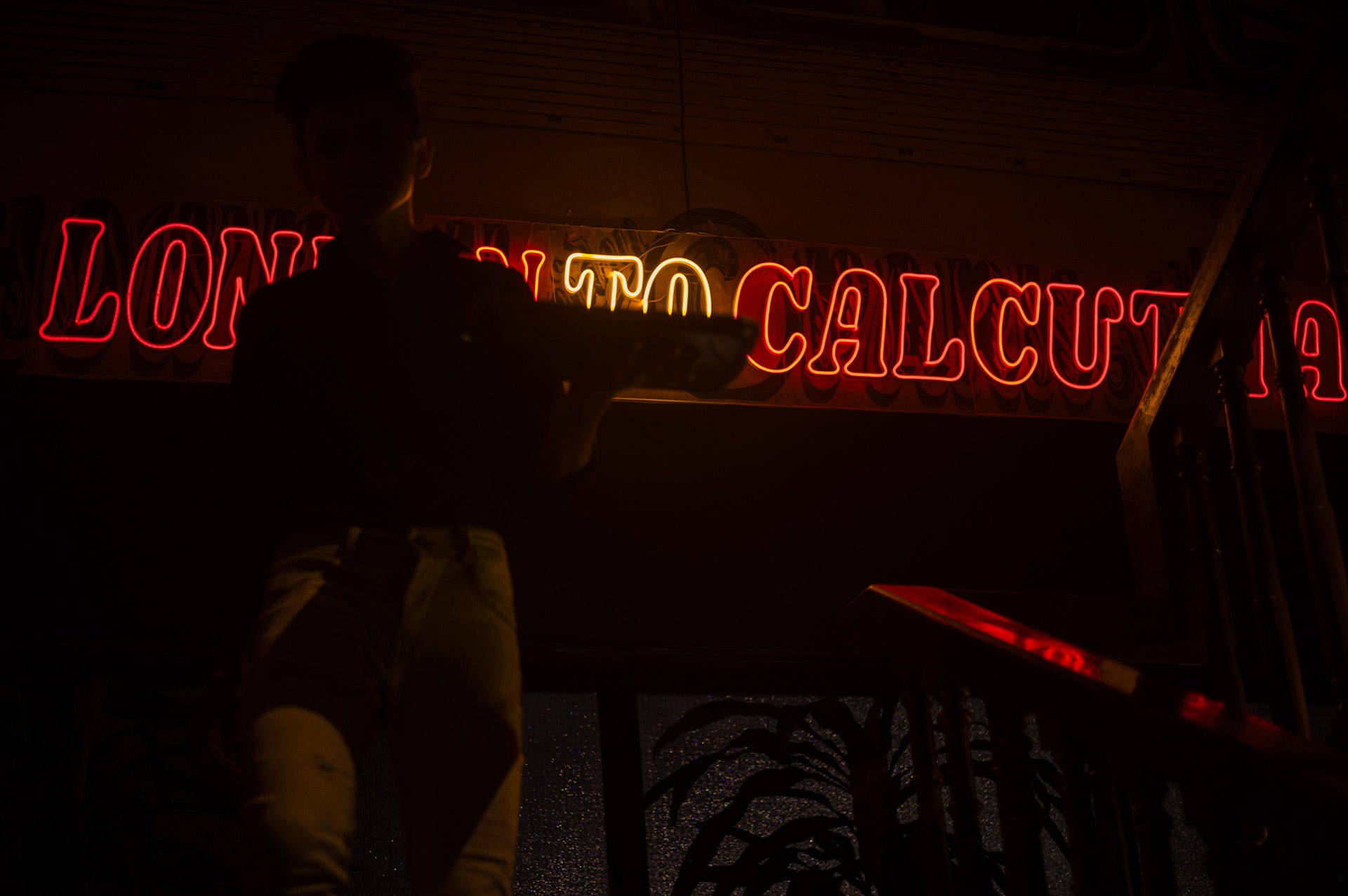
The month had flown by and the time had come to move on from Kolkata. At this point I had moved on from the homestay to a hotel on Central Avenue. My flight to Bangkok was planned for the next morning and I packed my bags to get ready. Feeling sentimental about my departure I reached out to a fellow photographer I had met earlier to ask if he wanted to share a beer on Park Street for a goodbye. To my pleasure he accepted happily and I took myself out for one last adventure. We met up at a club previously unknown to me. Its exterior was very humble which is probably what had made me miss it. We ordered a coconut rum and shared a plate of various Tikka delicates. Above us, through the transparent ceiling, feet moved in dark silhouette against the crimson-lit dance floor overhead.
A few drinks in we made our move upstairs. The energy was bustling. Abandoned tables filled with leftovers of hookahs, cigarette-filled ashtrays and drunk up glasses were placed along the walls and the crowd had moved in front of a small stage where the DJ played electronic music unts-ing to the rhythm of ecstatic heartbeats. I joined in on the dancing and willingly let the city shake me one last time.
Between dance moves, beers & balcony breaks the time had taken a leap and the place closed. Out on the street I said goodbye to my friend and fumbled into a yellow taxi that took me back to my hotel. To my shock the gate was closed and securely locked. I felt clueless in how to deal with the situation and started to think about ideas to spend the night as a homeless, among so many others, until the deliverance of dawn would come to my rescue and the gate would open. I squinted my blurry eyes and saw something resembling a doorbell next to the gate. I pressed it. Nothing happened. I pressed it again. I waited. Suddenly an old man appeared from the hotel entrance a dozen meters on the other side of the gate. The same man I had seen every morning sitting on a chair reading a newspaper as he guarded the gate from unwanted intruders. He walked extremely slowly, eyes barely open toward me. In an act of slow-motion he took up a huge keychain and began to unlock keylock after keylock. It took ages as he kept unlocking while muttering something I would guess was Bengali cursings and I stood waiting for him as a humiliated fool. Finally he could open the gate and I walked in, mixing apologies and thanks while I rushed into the hotel. Right inside the entrance I saw a thin, narrow mattress laying across the floor and I felt sorry for having disrupted this man’s already less-than-ideal sleeping situation. Knowing he would have to sit there guarding the same gate the next morning.
As the time had come to leave the city, I realized I had transformed from someone desperately trying not to disrupt the flow of the streets to someone waking innocent gatekeepers with drunken fumbling. I had gone from the disrupted to the disruptor.
Beautiful images Simon, I am in Pakistan in two weeks time and really can’t wait to work on my long term project! Hop over if you can!!
A fascinating read about a city one of my relatives visited not long after WW2. It looks and sounds like somewhere I suspect would only survive for a day or two.